
History of Baba Ramdev Pir)
Dalibai Meghwal and the Spirit of Equality
A defining chapter in Ramdev Pir’s life was his bond with Dalibai Meghwal, his dharmbehan (spiritual sister). Despite belonging to a marginalized community, Dalibai was honored and respected by Baba Ramdevji as an equal in devotion. Their relationship symbolized his stand against social discrimination and caste barriers. By addressing Dalibai as his sister, Ramdevji demonstrated that spiritual kinship transcends caste and birth, and that true bhakti is measured by purity of heart, not social rank.
Dalibai Meghwal attained Samadhi on Bhadon Sudi 9, Vikram Samvat 1515 (1459 A.D.), followed just two days later by Bhagwan Ramdevji Maharaj, who took Samadhi on Bhadon Sudi 11, 1459 A.D., only 20 feet away from her shrine.
Ramdev Pir and the Sufi-Ismaili Connection
Baba Ramdevji’s teachings reflected a deep harmony between Hindu Bhakti and Ismaili-Sufi mysticism. Rooted in the Sanatan Dharma, he embraced the universality of God as expressed in Islamic traditions. His association with Ismaili Shias and dialogues with Sufi saints earned him the title of Pir, a spiritual guide. For Muslims, he became Ramsha Pir, a symbol of divine love and unity. His inclusive philosophy made him a bridge between Hindu and Muslim faiths, and his name continues to be revered by both communities across Rajasthan, Gujarat, and Sindh.
Samadhi at Ramdevra and Everlasting Legacy
In his later years, Baba Ramdevji attained Samadhi at Runicha, now known as Ramdevra. His Samadhi Sthal became a sacred site for devotees of all faiths. The Ramdevra Temple stands as a testament to his eternal presence, where lakhs of pilgrims gather annually for the Ramdevra Fair — singing bhajans, aartis, and qawwalis in his honor. The temple resonates with his message of faith, equality, and spiritual unity.
Centuries later, Maharaja Ganga Singh of Bikaner constructed the magnificent Ramdevra Temple in 1931 A.D. over his Samadhi site. Devotees from all walks of life visit this sacred temple to offer rice, coconuts, churma, and toy wooden horses, symbols of devotion to the saint who rode a divine steed to aid the poor.
Every year, lakhs of pilgrims gather at the Ramdevra Fair, singing bhajans, aartis, and qawwalis in praise of the saint who preached that “all human beings — high or low, rich or poor — are equal in the eyes of God.”
Even after six centuries, Baba Ramdev Pir’s message remains timeless. Whether called Ramdevji, Ramapir, or Ramsha Pir, he continues to unite hearts across religions and regions. His life story — that of a Rajput saint of Runicha — inspires millions to walk the path of truth, humility, and service to humanity.
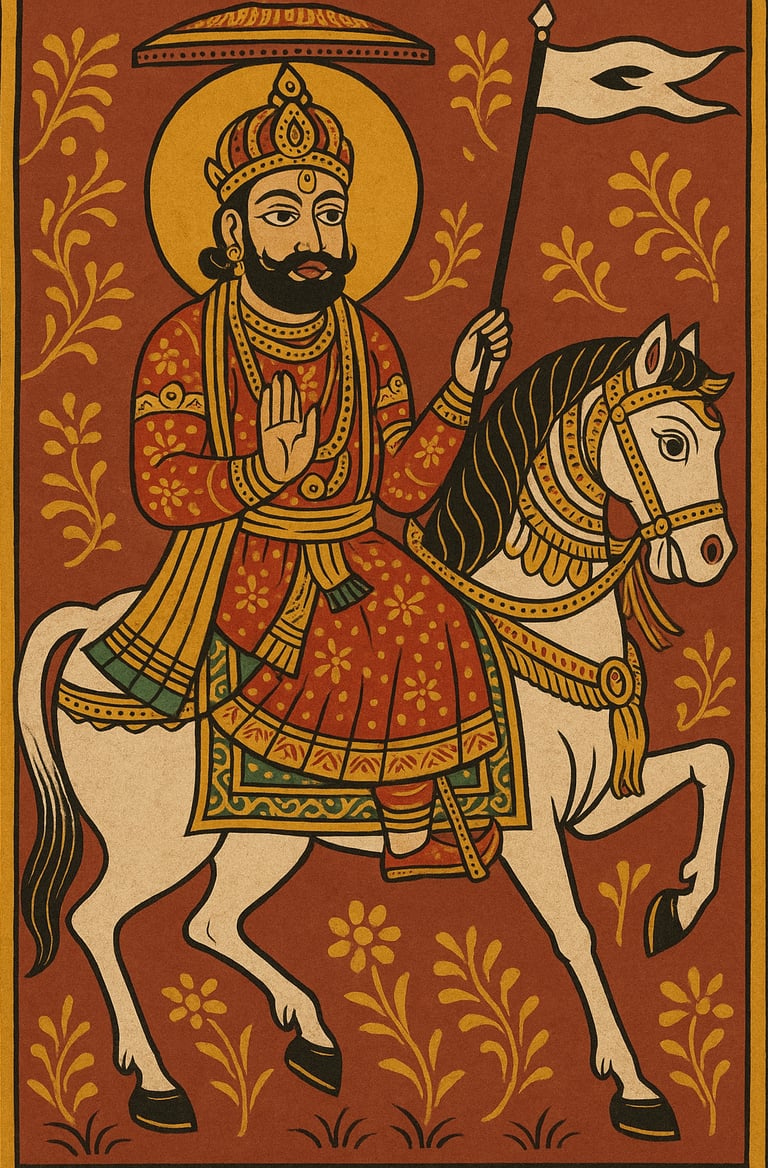
Birth and Early Life of Baba Ramdevji Tanwar
Baba Ramdevji Tanwar, also revered as Ramdev Pir or Ramapir, was a 14th-century saint and social reformer born around 1409 CE in Runicha, near Pokhran, Rajasthan. He descended from the illustrious Tanwar (Tomar) Rajput dynasty, whose ancestor King Anangpal Tanwar ruled Delhi around 1100 A.D. His father, Ajmalji Tanwar, became ruler of Pokhran, and his mother, Mainalde Bhati, belonged to the noble Bhati clan of Jaisalmer. The divine couple were blessed with two sons — Viramdevji and Ramdevji. From childhood, young Ramdevji displayed extraordinary compassion, miracles, and a deep commitment to justice and equality.
Marriage, Renunciation, and the Path of a Kshatriya Jogi
Though born into jagirdar pedigree, Baba Ramdevji chose a life of humility and service. He married Netalde Sodha, a princess of the Sodha Rajput clan of Amarkot. Despite his royal duties, he lived like a Kshatriya Jogi — combining the valor of a warrior with the renunciation of a saint. His life’s purpose was to serve humanity — feeding the poor, uplifting the oppressed, and spreading the message that all are equal before the Divine.
Ramdevji and Netalde Devi had two sons, Saadaji and Devaaji, and a daughter, Chandrakunvarba, who was born four months after his Samadhi. Chandrakunvarba was later married to Hapaji, son of Gogadevji of Satarva village. Saadaji eventually founded a new settlement named Saada, about 15 km from Ramdevra, where his descendants still live today.